Prepared for George Mattson · Wheels Up · September 2026
The other clubhouse.
Augusta is one week in April, built around golf. There is a professional tennis league eight weeks every summer, twelve miles from your building in Chamblee, in the one premium category your portfolio has never touched.
A partnership proposal · about five minutes
“This one you can have fun.” — in the stands, Atlanta
A gender-balanced Professional Team Tennis League
Eight playing weeks in the middle of the summer. Switch the view to see the
same season against the American sports year, or against the college calendar our players come from.
INTENNSE Grand Slams Team events
INTENNSE Regular season Postseason
INTENNSE Regular season Postseason & championships
2026 season. INTENNSE: 5 June – 1 August, 58 days, one dark week for Wimbledon. Sources: data.intennse.com/2026/calendar.tsv; published tournament calendars.2026 calendar year. The NBA and NHL finished on 13 and 14 June; the NFL’s season opens 9 September; LOVB ran January to April. Only MLB is in season through INTENNSE’s eight weeks. Sources: published league calendars; INTENNSE figures from data.intennse.com.NCAA Division I, 2026 as it happened. Both the men’s and the women’s team championships finished on Sunday 17 May at the Dan Magill Tennis Complex in Athens, Georgia — Virginia over Texas, Texas A&M over Auburn. The NCAA has moved singles and doubles out of May: they are now a November event, so a graduating senior has nothing left on the college calendar at all. Basketball’s season opened in November 2025; the January football block is the 2025 season’s playoff. D-I carries 5,207 tennis players across 541 programmes. Sources: ncaa.com championship releases, official school schedules, NCAA Sports Sponsorship and Participation Rates Report 2024–25.
Where our players have been on the tour, and where they sit on the rating that
covers everyone. The orange rule is where tennis starts paying for itself.
Career high September 2026MVP race ↗ (second scale) alone = no tour ranking, placed by MVP standingName in yellow = straight from college
Rounds 1–3 of the 2026 draft, plus three players the draft board leaves out altogether and one fourth-round pick: 56 in all. Forty-seven carry an ATP or WTA career high. The nine below the dotted line in each panel have no tour ranking on record and are placed by where they finished in the league’s own MVP race — among them Sofia Cabezas, fifth in that race, and Corey Craig, thirteenth, straight out of Florida State. Two more carry a career high but no current singles ranking, so they show a career-high dot alone. Fourth-round picks are otherwise excluded — 2027 rosters are three women and three men. The one exception is John Chin, 19th of 31 men over four Arcs, ahead of eight higher picks including two first-rounders. A player placed by MVP standing needs more than one Arc behind the number: Season Score is the sum of a player’s best six rounds divided by six, so a single appearance is not a season. Ranking axis runs worst to best, left to right, as in the UTR chart below. The MVP race is a separate scale, and it stops at our own best-ranked player rather than running the width of the chart — it ranks these players against each other inside the league, not against the tour. Aliona Bolsova sits inside that line on both counts: a career high of 88, inside a Grand Slam draw, and first in the 2026 MVP race. A career high is never drawn worse than the player’s current ranking: where a recorded best is stale, the best is at least today’s rank and the two collapse to a single point. Tier cut-offs: main draw top 128 — the draw size of a Grand Slam — Challenger 129–350, ITF Futures 351–900 (the ITF renamed the Futures circuit the World Tennis Tour in 2019). The orange rule is the break-even ranking — where prize money covers the cost of competing. It is drawn at ~150, which is where a peer-reviewed 2026 study puts it once a realistic cost base including a coach is counted — and every professional has a coach. The faint rule behind it is the ITF’s own 2013 figure, 336 for men and 253 for women, which sits at a worse ranking only because those costs exclude coaching and all support-team expense. It is the bar nobody actually competes under. Against the real bar: of the 26 men here with a career high, all 26 never reached 150; of 21 women, 19 never did — the exceptions are Aliona Bolsova at 88 and Usue Arconada at 130. On today’s rankings it is unanimous: 25 of 25 ranked men and 20 of 20 ranked women sit outside break-even. Sources: draft.intennse.com, stats.intennse.com MVP race, intennse.com player pages, Tennis Abstract, retrieved 20–21 September 2026; ITF Pro Circuit Review, Stage One: Data Analysis, December 2014; Schöttl et al., Social Sciences & Humanities Open, 29 June 2026.
UTR: our players against the tour’s
INTENNSE player Straight from collegeTop three picks per team Tour band (10th–90th percentile)
Bands derived from 286 players who publish both a UTR rating and an ATP/WTA ranking, taken at the 10th–90th percentile of each tier. INTENNSE ratings: the top three men and three women per 2026 roster — 28 men and 30 women carry a rating on the league’s own draft board. Source: draft.intennse.com players board, retrieved 20 September 2026.
Down to the wire; Sudden Death
Two Arcs that finished a point apart. Each clip picks up in the closing minutes,
with the full Arc a click away.
Sudden death, level at 142
The final three minutes of Freeze v Rise, 20 June. The clock runs out with the teams tied, and the next point decides it: 143–142.
1Times “tennis” appears in your SEC filing history
8 wksJune to August, twelve miles from Chamblee
65Pro Arcs in 2027, up from 43
393,492Atlanta households above $200,000
0Private aviation partners in the league
■ Your words, not ours
“While Augusta is our flagship event, we leverage our core competency in
hospitality through smaller, curated experiences throughout the year. These experiences
reinforce customer loyalty, expand engagement with new partners, grow our brand, and
highlight the differentiated nature of the Wheels Up offering.”
George Mattson · Q1 2026 Investor Letter, filed 11 May 2026
This is a proposal for one of those. Augusta is a week
in April, in Georgia, built around golf. We are eight weeks in June and July, in Atlanta,
twelve miles from your building — in the season your own 10-K names as your
busiest, feeding the quarter it names as the one in which members buy.
“Our operations, including Flight revenue, have historically been favorably
affected by increased utilization of our services in the summer months… we have
historically experienced the highest volume of Membership Fund purchases in the fourth quarter of
each calendar year.” — Wheels Up FY2025 Form 10-K.
■ The empty square
The word appears once in everything Wheels Up has ever filed.
Kenny Dichter, on an investor call in 2021, reaching for a way to describe
the cheapest membership tier: “We think of it like a tennis membership at the golf
club.” That is the entire tennis footprint of this company, and it was a
metaphor.
Flexjet has tested this and doubled down. They joined the Laver Cup as a
sponsor in June 2025 — their CMO saying the sport “resonates powerfully with
our ultra-high net worth clientele” — and in June 2026 they came back and
took the category title outright, as Official Private Aviation Sponsor.
A year of evidence, then a bigger cheque.
NetJets is the tell in the other direction. Their only tennis page is about
Owners who are competing in the US Open — they already fly the players, and
they have never bought the sport.
Metro Atlanta, on a Friday night in July
Full-text search of every Wheels Up filing on EDGAR: “tennis” —
one result. “Golf” — eighteen.
■ The city you moved to
Atlanta plays more league tennis than anywhere in the country, and has had no professional
tennis since 2024.
The Atlanta Lawn Tennis Association was founded here in 1934 and describes
itself as the largest tennis-based community organisation in the world, with roughly
60,000 members across the metro. Nationally, 27.3 million Americans played
tennis last year and 39% of them live in households above $125,000 — an
index of 147 against the general population, and about 10.6 million people.
The ATP’s Atlanta Open ran here for fourteen years and was gone from the
calendar after July 2024. Since then this city has had no professional tennis at all, except
ours — and this month Nielsen put Atlanta fifth on the list it published of
America’s strongest tennis markets, behind New York, Miami, Palm Springs and West
Palm Beach, on a nine-factor index covering US Open viewership, live attendance, participation
and tennis-related travel.
Against golf, on the only scorecard neither sport wrote.
Both bodies publish flattering numbers about their own participants — ours
included, and you should discount them accordingly. So here is the last occasion on which golf
and tennis were measured on a single instrument and the household-income
cross-tab was published openly: the National Sporting Goods Association’s participation
study, reproduced by the US Census Bureau in its Statistical Abstract of the
United States.
Household incomeUS populationGolfTennis
$100,000 and above21.0%34.5%37.5%
Indexed to the population100164178
$75,000 and above36.4%55.0%55.6%
Tennis players were more concentrated in
six-figure households than golfers, and third of the thirty-five activities measured.
At $75,000 and above the two sports were a dead heat.
The number that argues against us is worth putting up too, because your team
will find it: 39% of American tennis players play mainly in a public park, and
only 17% at a private or country club. Tennis out-indexes golf on affluence while being
played mostly on free courts — which is a stranger and more useful fact than the one a
rate card would give you.
US Census Bureau, Statistical Abstract of the United States: 2012,
Table 1249, from NSGA Sports Participation — a questionnaire mailed to 10,000
households, participants aged 7+. The data year is 2009, and it is the most
recent like-for-like measurement in open publication; the National Golf Foundation holds current
golfer income behind membership. Venue and $125,000+ figures are the USTA’s 2026
participation report, drawn from the Physical Activity Council study — 18,000 interviews,
independently fielded, though the USTA chooses which cut to publish.
Your own runwayDeKalb-Peachtree is the second-busiest airport in Georgia and
fifteenth in the United States for itinerant general-aviation and air-taxi movements, up 32%
since 2019.FAA Terminal Area Forecast
Your own market393,492 metro households above $200,000 — 16.5% of the
metro against 13.7% nationally.Census ACS 2024
Your own seasonWe play June to August. The NBA and NHL have finished, the NFL
has not started, and nothing else in this city is competing for a
Friday night.Eight weeks
Your own customersYour 10-K already names sports teams and athletes as a
customer segment, and you run an industry page for them.A sponsor and a buyer
■ What this actually is
Three women and three men, one score, an hour and forty minutes.
Every point counts the same whoever wins it, so the scoreboard never stops
and the finish is rarely settled early. Two Arcs last season were decided by a single point.
Forty-three Pro Arcs in 2026, sixty-five in 2027, every one carried live,
inside a wider season of fifty-four Arcs.
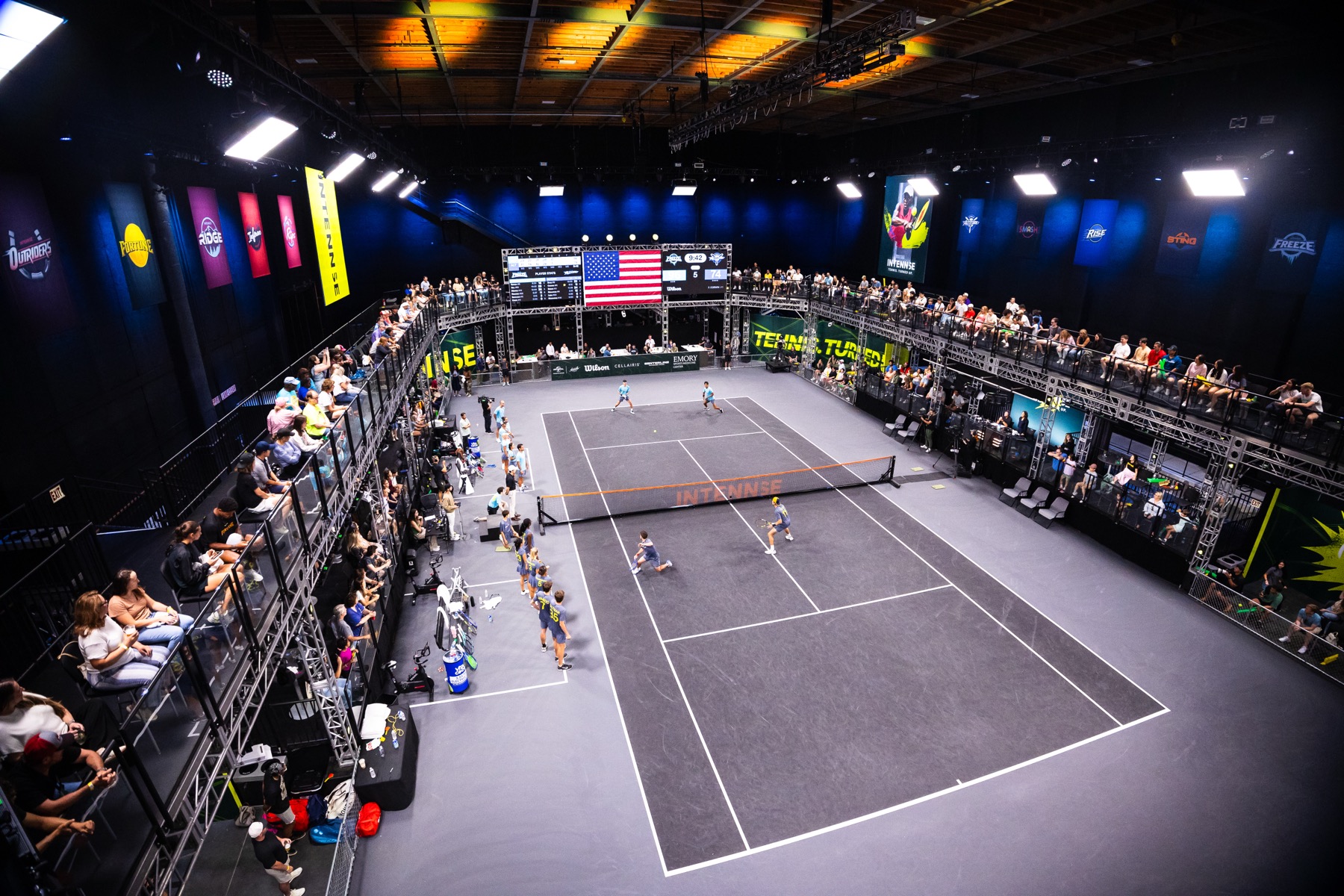
The court is small and the crowd is on top of it. That is the part that
matters for you: there is no upper bowl, no distance, no bad seat. It is a room, not a
stadium — which is the only kind of venue where hospitality is the product rather than
an add-on.
INTENNSE Arena — the crowd is on top of the court
■ The proposal
A second clubhouse, and it runs for eight weeks instead of one.
Not a perimeter board. A member programme, built the way you already build them
— and the reason to buy it is retention, not awareness.
VistaJet runs Vista House at Augusta and calls it “an intimate
clubhouse” for members. You run yours in the same town in the same week. Both are four
days, once a year, in a market with almost no commercial lift. This is the inverse
trade — a lower peak, far more often, in a city you already operate from.
The roomA standing Wheels Up space inside the Arena for the season, with the
court a few feet away. Members bring guests; guests are the pipeline.Eight weeks,
not one
Play the professionalsThe Challenge Series is an open-entry draw inside every
event — 16 men, 16 women. The top three of each earn a place on a team that plays a
professional side that week. A member can enter it.Unsold
Into the clubsExhibitions and showcases run in club settings across the metro
through the season, on any day of the week, with players present as part of the
commitment.Where your customers already are
Category exclusivityOfficial private aviation partner of the league, its
teams and its broadcast. Thirteen corporate partners signed for 2026 and none of them is in
your category.Open
Signature entry is a $200,000 fund. On your own
published spend model that is the entire annual private-flying budget of a household in the
$10–50 million band. One member pays for a season of this several times
over — which is the arithmetic that makes it a sales line rather than a marketing
line.
■ The Delta question
You already share a building with them without sharing a deal.
Delta is your largest shareholder and lead strategic investor, with roughly
36% of the equity and voting rights capped at 29.9%. You served eleven years on that board
and chaired its Finance Committee. So the obvious question about any sponsorship is whether
it tangles with theirs.
It is already answered, by you. Inside State Farm Arena, Delta holds the
Fly-Through Lanes and Wheels Up holds the courtside VIP entrance — two partners, one
venue, different assets, different audiences. Delta buys the whole building. You buy
the door only some people walk through.
The community programme
Delta is the official airline of the Braves, the Falcons, Atlanta United,
Mercedes-Benz Stadium, the Hawks, Georgia and Georgia Tech, and the official global airline of
the PGA Tour. There is no tennis anywhere in that portfolio. We have written to them separately
about the league; the two conversations do not depend on each other.
■ Who is already inside it
Every team carries a person, for the season.
When you signed Ben Griffin in January you did not talk about glamour. You
talked about “a flexible travel approach that adapts to his life, whether navigating a
demanding schedule or ensuring family can be by his side.” That is a description of
almost everyone below — people who move constantly, for work, with families who would
rather they did not.
A Pulse Partner is attached to one team, all season, in public. They are at the
Arcs, they are in the room, and their audiences follow them there.
The Bryan BrothersThe most successful doubles team in the history of the
sport, and two decades of living on aeroplanes to do it.Smash
Sloane StephensUS Open champion, 2017.Rips
Diego SchwartzmanFormer world No. 8 and a Roland-Garros
semi-finalist.Ridge
Martin BrodeurThree Stanley Cups, Hall of Fame, and more wins than any
goaltender in NHL history.Freeze
Terrell OwensPro Football Hall of Fame.Inferno
DJ IrieOfficial DJ of the Miami Heat.Sting
Shep RoseSouthern Charm.Outriders
Toya Bush-HarrisMarried to Medicine.Rise
■ The ask
An hour, and we will bring the room plan.
You have said the hospitality platform is looking for new partners. This is one
that sits in your own city, in your own season, in the only premium category your portfolio does
not touch — and it is unclaimed because nobody has built professional tennis here before.
If it is worth a conversation, we will come with the full inventory, what each
asset delivered in 2026 where we can prove it, and what a member programme would look like
costed.